

How Proposify reduced support costs and generated revenue from CX.
Proposify is a proposal-management platform that thousands of B2B sales teams use to write, send, and close deals. The customer base looks exactly like the audience this category was built for: high-volume, sales-led, product-heavy, with a steady stream of repetitive product questions hitting a customer experience team that was never staffed to be the bottleneck on growth.
When Jacqueline Antworth joined as Director of Customer Experience, the strain was visible in the numbers. The team was lean. Ticket volume averaged in the hundreds to low thousands per month. Most of those tickets were repetitive product questions that didn't require a senior CX hand to resolve, but were consuming one anyway.
Within two months of deploying an AI agent against the repetitive volume, the same team was running on 30% lower ticket volume, roughly 200 fewer tickets per month, with a 45% peak end-to-end resolution rate on the AI side. The freed capacity didn't go back into the cost-savings column. It went into work that drives revenue.

Before: a lean team at the edge of capacity
Proposify's CX function had three structural problems before the rollout.
The first was sheer volume, hundreds-to-thousands of tickets per month, the bulk of them repetitive product questions about template setup, sending mechanics, account configuration, and integration behavior.
The second was the leverage problem. Every one of those repetitive answers still required human time, and the team was small enough that any volume spike pushed response times in the wrong direction.
The third was an operational drag most B2B teams will recognize: two separate knowledge bases, neither of which mapped cleanly to where customers actually asked questions.
Having a lean team that can service high-volume customers was really important. We needed a solution that could tackle the simple product questions so we could go deeper on the strategic ones.
That's the cost-center trap exactly as McKinsey's customer-care research describes it: a function that is fully utilized handling work that doesn't require its expertise, with no remaining capacity for the work that actually compounds.
Implementation: what got automated first
The Phase-1 work was deliberately narrow. Rather than try to cover the full intent map on day one, Proposify deployed against the repetitive product-question categories that were consuming the most human time and had the cleanest resolution paths. The AI agent ingested both knowledge bases and bridged them into a single customer-facing interface, solving the operational-drag problem in the same motion as the deflection problem.
The setup was, in Antworth's words, the "bare minimum." That matters: the resolution numbers above are floor numbers, not ceiling numbers, and they came in well above the company's expectation.
A second decision shaped the outcomes. The AI didn't just answer questions, it took actions where the resolution path required them, and handed off cleanly when it didn't. This is the implementation pattern Bain's customer-experience research identifies as the structural unlock: AI deployments that compress cost-to-serve while improving CX are the ones where the system acts rather than narrates.
After: the numbers
Two months in, the picture looked like this.
Reduction in ticket volume, equivalent to roughly 200 fewer tickets per month hitting the CX team. The 200-per-month number is the floor, peak weeks ran higher.
AI outcome rate at peak, with a steady-state band of 30–45%. End-to-end resolution, not deflection, the customer's issue was actually resolved by the AI without human follow-through.
Knowledge bases unified into a single AI interface, eliminating the routing and discovery overhead that had been a quiet tax on every customer conversation.
The cost-side math, modeled at neutral industry benchmarks: McKinsey's contact-center research finds AI agents have already halved cost per call in mature deployments, and BCG's agentic-AI work in service operations puts the per-interaction cost reduction on automated flows at roughly 10×. Even at the conservative end of that range, 200 tickets per month moving from human to AI outcome translates to high five-figure annual savings on cost-to-serve alone, before any of the second-order effects on response time and customer experience.
But cost savings is the small half of the story.
The revenue half: what a freed-up CX team does next
The 200 tickets per month that left the queue didn't take 200 tickets' worth of human capacity with them. That capacity stayed on the team. Where it went is the part of the case study Proposify is still actively building, and it's the part most B2B leaders should be paying closest attention to.
Antworth's own description of the redirected work, "high-impact project work rather than low-hanging fruit questions", maps directly onto the revenue-adjacent activities that drive net revenue retention in B2B.
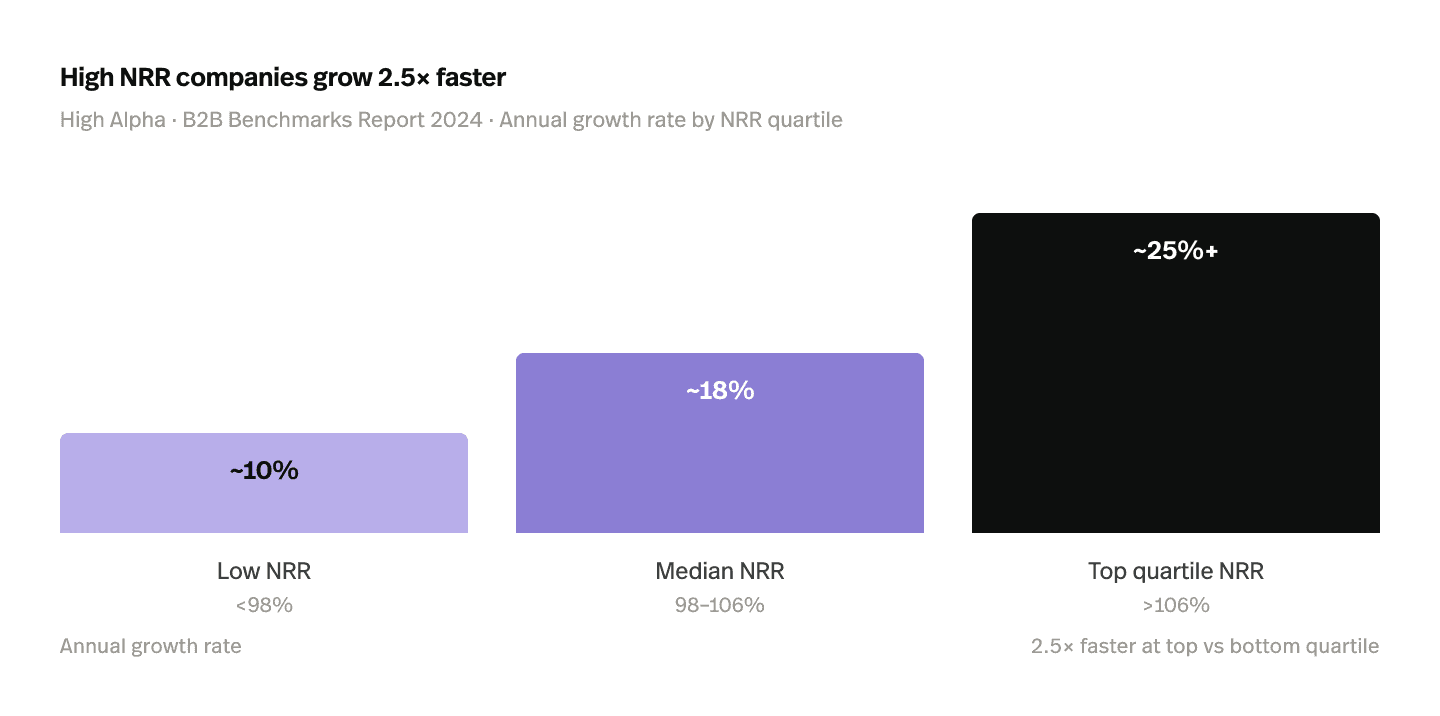
For a sales-tooling B2B like Proposify, the practical shape of that redirected capacity is concrete:
- Structured onboarding outreach to drive faster time-to-first-proposal, the leading indicator of long-term retention in template-heavy products.
- Expansion conversations triggered by usage signals: customers approaching template limits, hitting integration ceilings, or showing patterns that correlate with seat-add events.
- Proactive churn intervention on accounts where the support signal flags risk before the renewal cycle does.
- Quarterly business reviews on key accounts that previously got auto-renewed without a human ever reaching out.
Harvard Business Review's case research on automation-driven role redesign is explicit on this point: the organizations that capture the full economic value of automation are the ones that redeploy freed capacity into higher-value work, not the ones that bank the savings and shrink the team.
What this case study really shows
Proposify's CX function went from a cost line that scaled linearly with ticket volume to a function with two distinct economic outputs: a lower cost-to-serve on the routine half of the queue, and a redeployed human team operating on the work that compounds, onboarding, expansion, retention. Same headcount. Different math.
That's what "support as a revenue engine" looks like in practice, with real numbers attached. Not a slide. Not a thesis. A 30% drop in ticket volume, two months in, on a bare-minimum setup, and a CX team that finally has the bandwidth to do the work the business actually needed them to do all along.
The full Proposify story
The published Proposify case study walks through the rollout in detail, including the integration sequence, the categories Helply tackled first, and what Jacqueline's team is doing with the freed capacity now. Read the full case study →
Sources
- Helply · Proposify case study
- McKinsey · Building trust: How customer care leaders pull ahead with AI
- McKinsey · The net revenue retention advantage: Driving success in B2B tech
- BCG · Agentic AI Is the New Frontier in Customer Service Transformation
- Bain & Company · AI Won't Just Cut Costs, It Will Reinvent the Customer Experience
- Harvard Business Review · How Amazon Automated Work and Put Its People to Better Use