

Support isn’t a cost center. You just built it like one.
For most of software history, support has lived on the wrong side of the P&L. It shows up under G&A or Operations, gets measured by tickets closed and average handle time, and gets benchmarked against headcount efficiency. When the CFO needs to find margin, support is the first place they look, because the only levers it's been given are cost levers.
That framing is wrong. And it's expensive to get wrong.
The teams growing fastest aren't squeezing their support functions. They're rebuilding them. They're treating support as the only function in the company that talks to every customer every month, and asking what that's actually worth. The answer is a lot more than a closed ticket and a satisfied survey score.
The perverse incentive at the center of the cost-center model
The cost-center frame creates a specific kind of organizational damage. When every dollar your support team spends is, by definition, a dollar of margin lost, the function gets squeezed: fewer reps per thousand customers, faster handle times, more scripted macros, chatbots that can't actually resolve anything. The metrics improve. The customer experience degrades. Churn quietly creeps up.
McKinsey surveyed 440 customer-care leaders and found that the top decile, the firms outperforming peers on growth and retention, explicitly treat support as a strategic revenue engine, not a cost line. That's not semantics. It determines what you measure, what you build, and what you give the function permission to do.
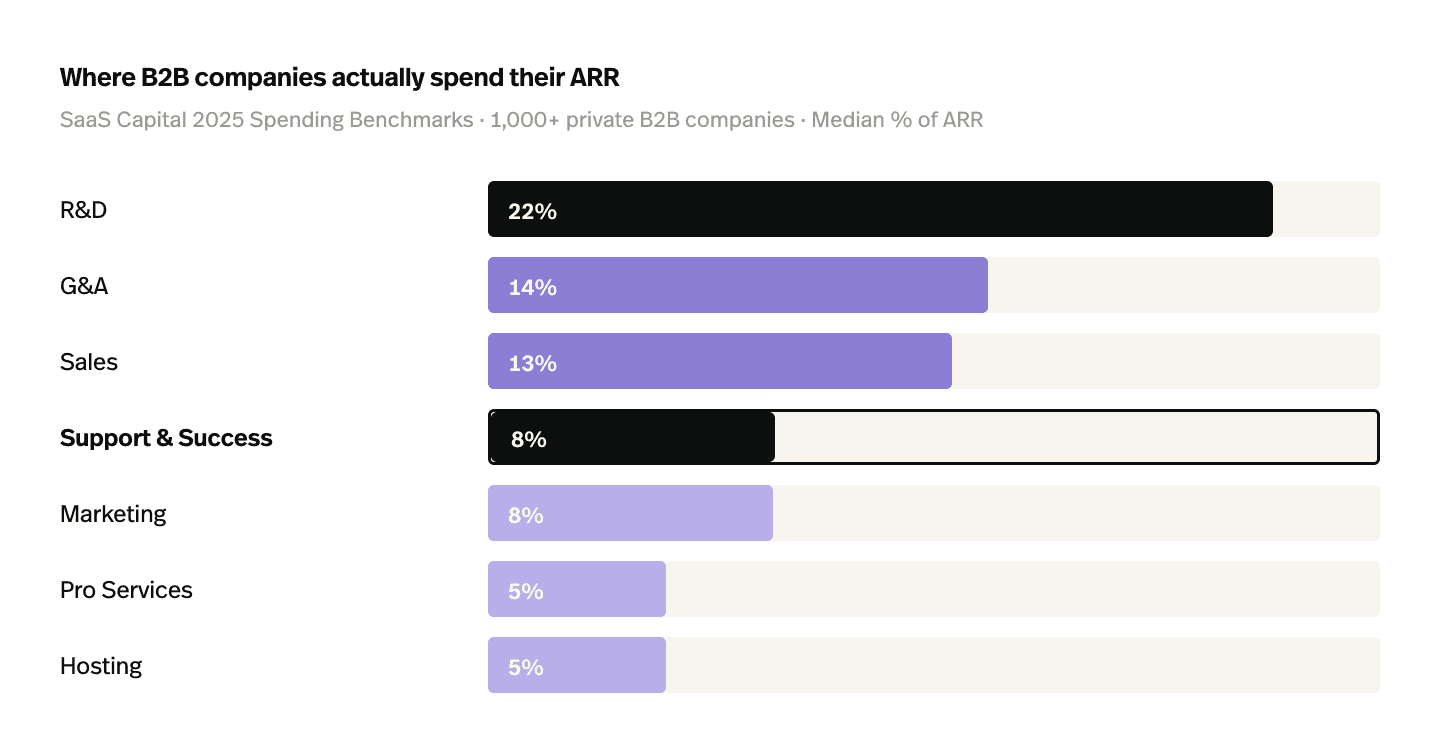
The cost-center reflex is to shrink the support budget. The revenue-engine reflex is to ask what it's doing.
Most of what your team handles shouldn't hit a human
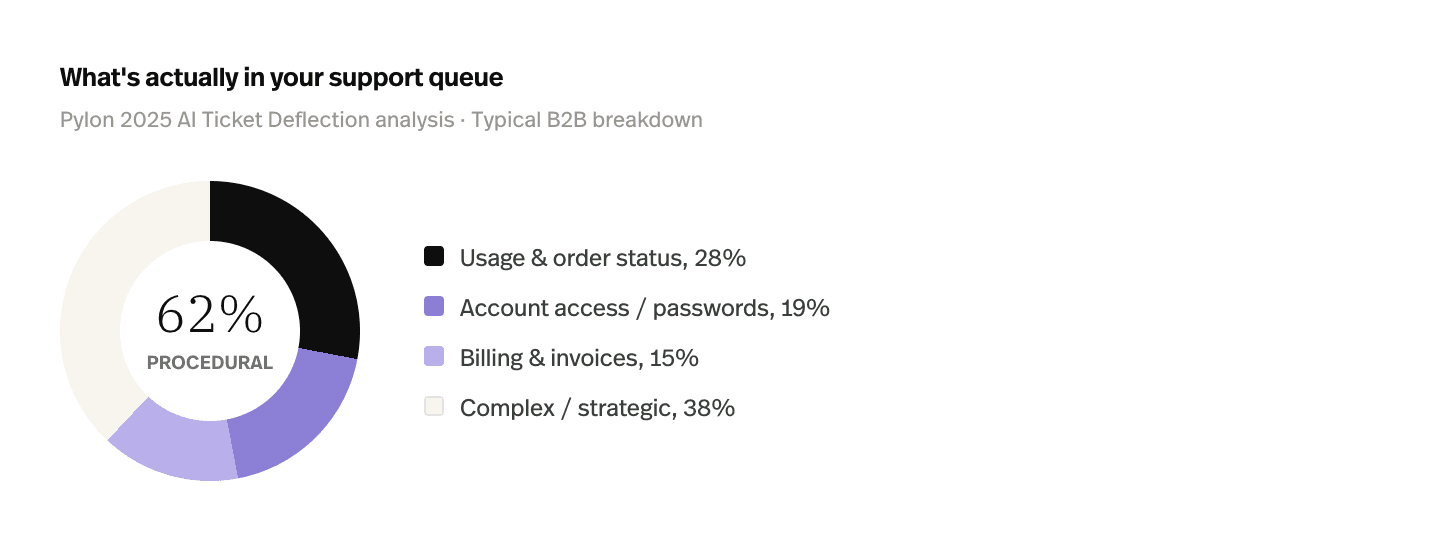
When you decompose a typical B2B support queue, the numbers are hard to look away from. Usage and order-status questions account for around 28% of tickets. Account access and password resets, another 19%. Billing and invoice questions, 15%. That's over 60% of volume that is fully proceduralized work, the kind that needs correct execution, not empathy or judgment.
Of routine queries are being resolved automatically in enterprise deployments today, per Zendesk's 2025 CX Trends report. Gartner projects agentic AI will autonomously resolve 80% of common service issues by 2029, not as an aspiration, but as a trajectory already underway in the leading deployments.
The math, written out
Take a 10,000-ticket-per-month support operation. At $30 per ticket in human cost (the B2B midpoint), that's $300,000 a month in resolution cost. AI outcome costs cluster between $0.50 and $2.37 per ticket depending on complexity.
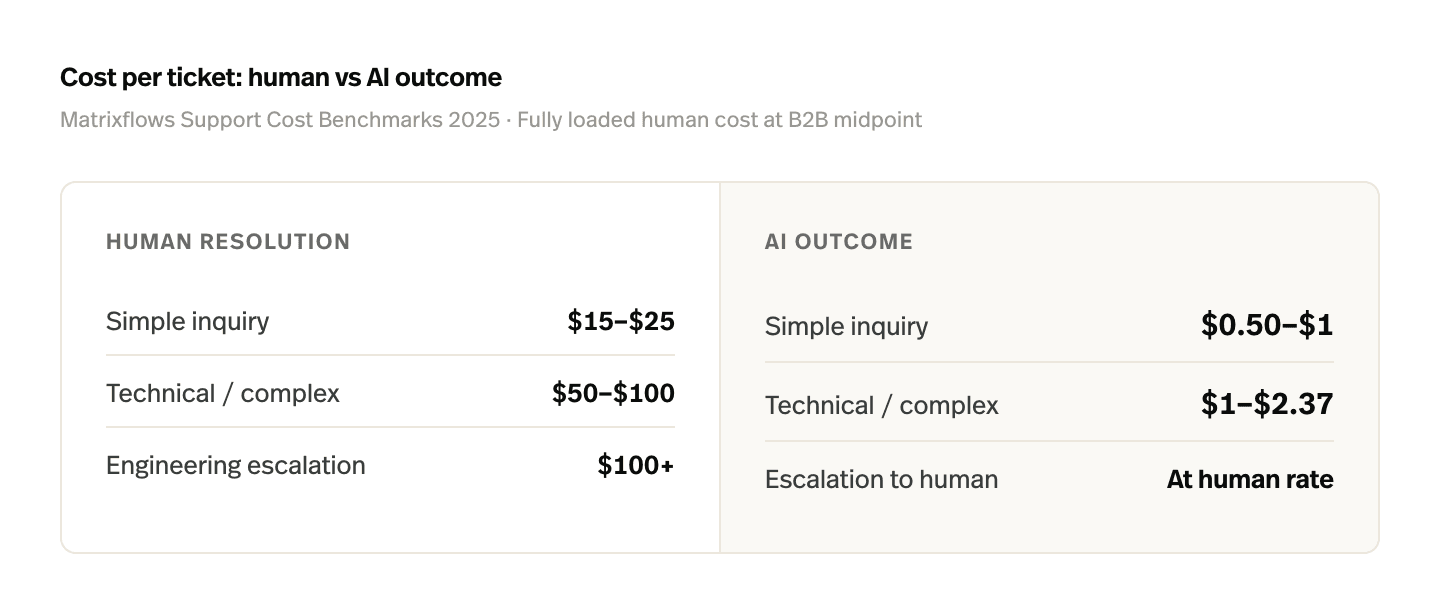
$1.68M a year freed up. The cost-center playbook banks it and takes the headcount hit. The revenue-engine playbook keeps the team and redirects them.
BCG puts the cost differential at roughly 10x lower per interaction for agentic AI. McKinsey reports AI agents have already halved cost per call in modern deployments while CSAT held or improved. These aren't projections. They're benchmarks from teams that have already made the shift.
What this looks like in practice
Proposify runs Helply alongside their existing support stack. Within two months: 45% AI outcome rate, 30% reduction in ticket volume, 200 fewer tickets per month reaching the team. Jacqueline Antworth, their Director of CX, describes it as her team getting their time back for strategic work.
Kameleo hit a 78% AI outcome rate in 30 days, including for complex code generation questions. Three times faster response times. Engineers moved from answering the same technical questions to actually improving the product.
Reallocation is where the revenue shows up
Here's the part the cost-center framing misses entirely: the hours freed up from routine tickets aren't neutral. They're the most valuable hours in your company when redirected correctly.
Gartner surveyed 321 customer service leaders and found that 50% of organizations have already abandoned plans to reduce their support workforce due to AI. Nearly 80% are planning instead to transition agents into new roles built around complex and high-value interactions. They're not cutting. They're upgrading what the team does.
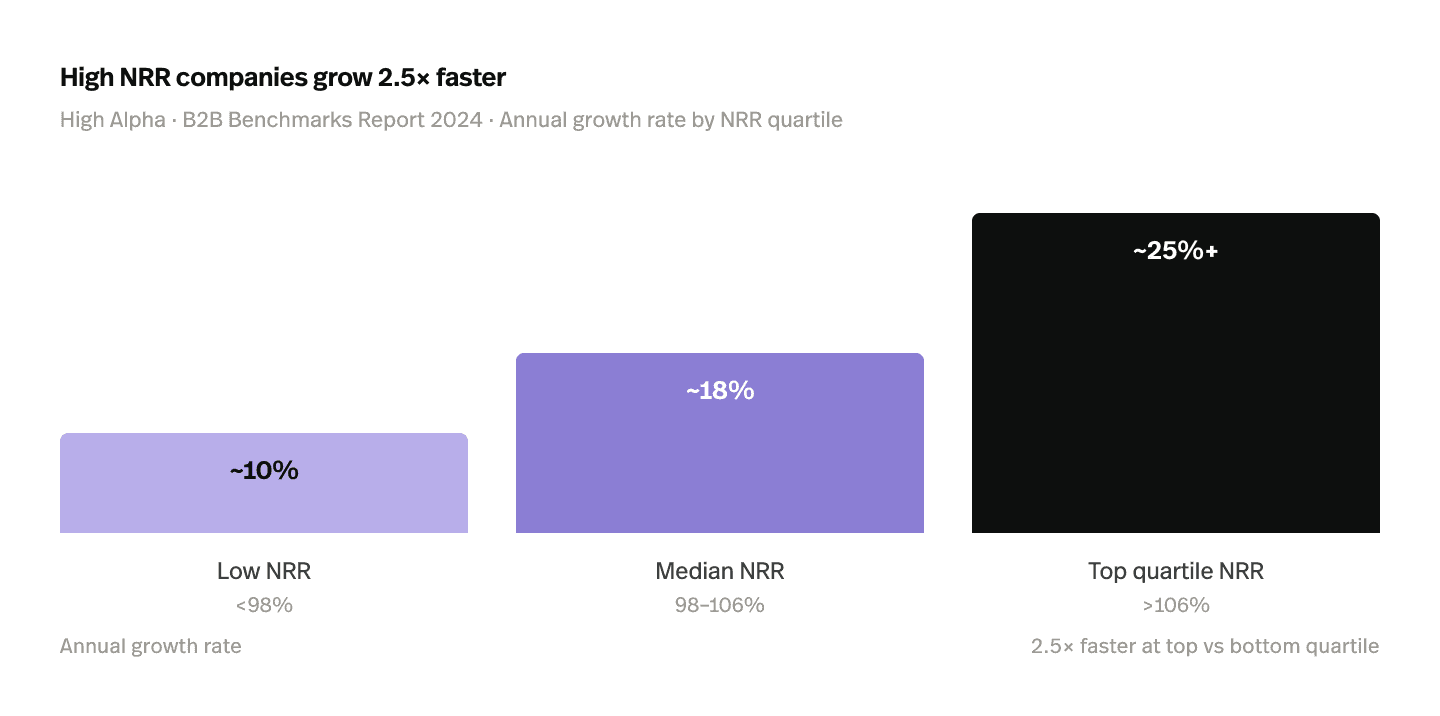
Faster growth at top-quartile NRR companies, according to McKinsey's B2B tech research. The difference between a team spending their time on password resets versus expansion conversations is, literally, the difference between these two growth trajectories.
The math is simple. A support rep redirected from "how do I reset my password?" toward an at-risk renewal call or an expansion conversation is the highest-leverage hour in a B2B company. Not theoretically. Literally. Expansion revenue at above $50M ARR surpasses new sales. The rep on the renewal call is doing more for the P&L than the rep answering the billing question.
Every ticket is a signal. Most companies throw them away.
There's a third thing the cost-center model misses, and it might be the most expensive miss of all.
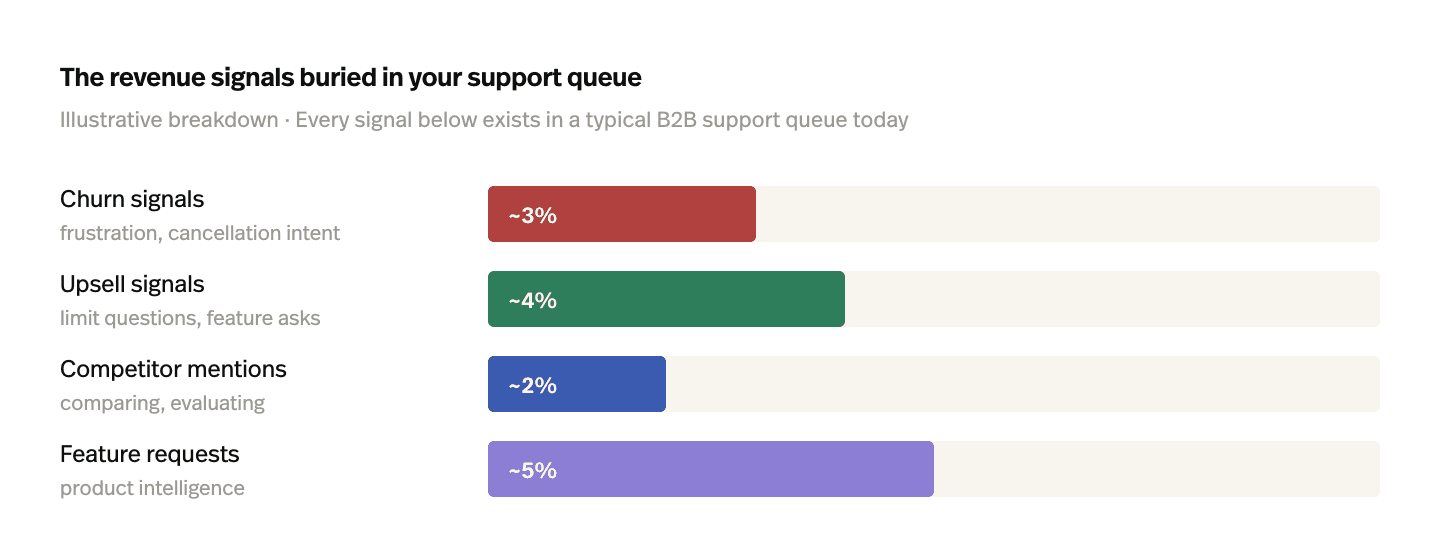
Your support queue is not just a list of problems to resolve. It's a continuous stream of customer intelligence: who's frustrated, who's about to churn, who's asking questions that signal they're ready to expand, who mentioned a competitor last week. At the scale most B2B companies operate, that signal is constant. It happens every day, in every conversation.
Under the cost-center model, that signal goes nowhere. Tickets get closed, the queue empties, and the business learns nothing. The customer who asked three billing questions before churning never triggered a retention conversation. The customer who asked about a feature your product already has never got the upsell call. The customer who mentioned a competitor by name got a generic response.
Revenue intelligence in practice
This is the core of what Helply is built to do. Churn risk detected means the account team gets an alert before the customer cancels, not in the exit survey. Upsell flag means sales knows which customers are ready to expand before they ask. Competitor mention means the conversation gets shaped while there's still time to influence the outcome.
Sender.net handles 4,036 support interactions every month across 180,000 customers. Under their old stack, every one of those signals was going nowhere. See how it works →
What a revenue-engine support function actually looks like
A support function operating as a revenue engine has three things the cost-center version doesn't.
It tracks revenue-linked outcomes alongside efficiency metrics: churn prevented, expansion identified, NRR contribution per agent. Not just resolution time and handle speed. It has clear tiers where AI handles tier-1 work, password resets, billing lookups, plan changes, seat additions, refunds within policy, and humans handle anything that touches retention, expansion, or product strategy. And it shares its intelligence with sales and product, because every ticket is now a signal about willingness to pay, friction points, and expansion intent.
The teams furthest along aren't the ones who fired their support reps. They're the ones who realized that paying a human to answer "where's my invoice?" was never the job. The job is keeping customers, growing them, and turning the only function that talks to every customer every month into the one that drives the most revenue per headcount in the company.
That shift doesn't require cutting the team. It requires giving them harder, better-paid problems to solve and building the infrastructure that makes that possible.
The framing was always wrong. The good news is it's not that hard to fix.
Sources
- McKinsey · Building trust: How customer care leaders pull ahead with AI
- McKinsey · The net revenue retention advantage: B2B tech
- Gartner · Agentic AI will resolve 80% of common service issues by 2029
- Gartner · 50% of organizations will abandon workforce reduction plans
- BCG · Agentic AI is the new frontier in customer service transformation
- SaaS Capital · 2025 Spending Benchmarks for Private B2B
- High Alpha · Net Revenue Retention: Why it's crucial for B2B growth in 2025
- Pylon · AI Ticket Deflection: How to reduce support volume
- Zendesk · 2025 CX Trends Report
- Matrixflows · Support Cost Benchmarks 2025

