

Best Helpdesk Ticketing Systems for Small Business (2026)
Key Takeaways
- Per-seat, per-outcome, per-session, and flat-rate pricing produce wildly different costs for the same workload, and the difference compounds every month.
- Free tiers from Freshdesk (2 agents), Zoho Desk (3 agents), and Hiver (unlimited users, basic triage) work for getting started but hit hard limits on automation, SLAs, and reporting within 3 to 6 months of real use.
- B2B support is fundamentally different from B2C: lower volume, higher stakes, known accounts, and every ticket is revenue data. Most helpdesks are built for high-volume deflection, not account intelligence.
- AI add-on pricing is the new hidden cost. Zendesk Advanced AI adds $50/agent/month. Freshdesk Freddy charges $49/100 sessions after the first 500. Most comparison articles never mention this.
- If your team lives in Gmail, Hiver works without a platform switch. If budget is the priority, osTicket is fully free and self-hosted. If you want the deepest feature set and can stomach the price, go for Zendesk.
Three support agents. A shared Gmail inbox. And the same customer email sitting unanswered for four days because nobody knew who owned it.
That is the exact moment most B2B teams start searching for a helpdesk ticketing system. The inbox worked fine at 50 tickets a month. At 300, it is chaos. Two agents reply to the same thread.
A billing question from a $40K ARR account gets buried under password resets. The founder asks what support is costing the company, and nobody has a number.
In this post, we’ll discuss the 10 helpdesk ticketing systems for small business teams in 2026. Real pricing (including AI costs most articles hide), strengths, weaknesses, and the specific team type each tool fits best.
Plus a breakdown of four pricing models, with the math on what your ticket volume actually costs on each platform.
Best Helpdesk Ticketing Systems for Small Business at a Glance
Here are the 10 best helpdesk ticketing systems for small business teams in 2026, ranked by the use case they serve best.
| Tool | Best For | Starting Price | Free Tier |
|---|---|---|---|
| Helply | B2B teams that sell software | $0/mo (pay per outcome) | Yes (full platform) |
| Zendesk | Large teams needing deep customization | $19/agent/mo | No |
| Freshdesk | Budget-conscious teams getting started | $15/agent/mo | Yes (2 agents) |
| Help Scout | Lightweight email-first support | $25/user/mo | Yes (up to 5 users) |
| Hiver | Gmail-native teams | $25/user/mo | Yes (unlimited users) |
| Zoho Desk | Zoho ecosystem users | $7/agent/mo | Yes (3 agents) |
| Front | Collaborative B2B operations | $25/seat/mo | No |
| HelpDesk | Complex B2B workflows | $29/agent/mo | No |
| JitBit | Technical support with strong automation | $29/mo (1 agent) | No |
| osTicket | Self-hosted teams on zero budget | $0 (self-hosted) | Yes (fully free) |
Outcome pricing changes the math for B2B teams. See what your ticket volume would actually cost. Request access to Helply.
Helply: Best for B2B Teams That Sell Software
Helply is a B2B AI-native support platform built for technical companies that sell software. It is the only platform on this list where the entire helpdesk layer is free forever.
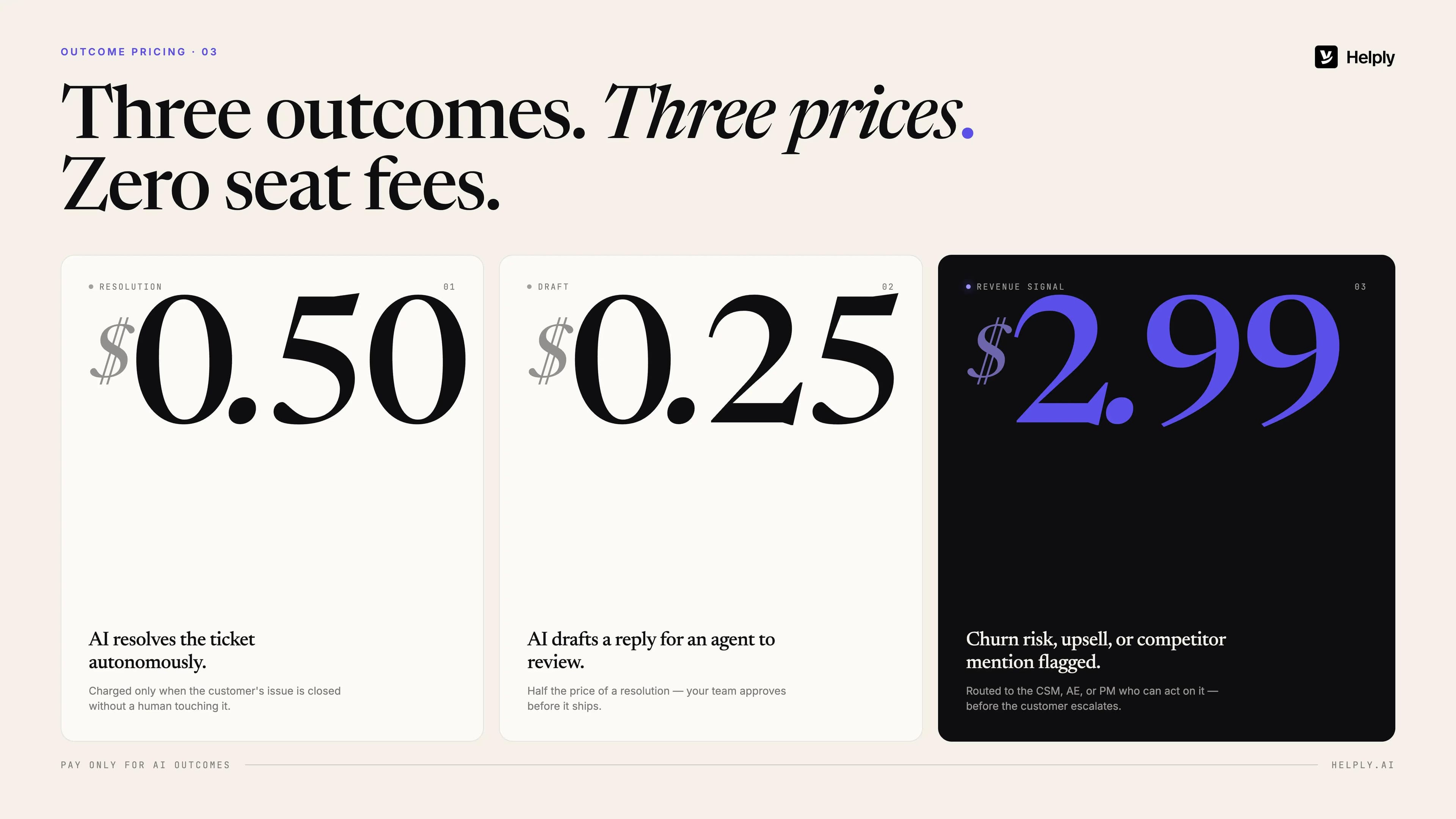
You pay per outcome: $0.50 when the AI resolves a ticket autonomously, $0.25 when it drafts a reply for an agent to review, $2.99 when it flags a churn risk, upsell opportunity, or competitor mention.
The AI’s most valuable role in B2B is not closing tickets on its own. It is making human agents dramatically faster and sharper.
Helply drafts every reply with sources and full account context, surfaces the right answer from Gong calls, Stripe billing data, Salesforce records, and product usage patterns, and hands the agent a reply they can send in seconds.
Where most helpdesks show a ticket in isolation, Helply shows the ticket inside the account. Every conversation loads with ARR, renewal date, product usage, CRM data from Salesforce or HubSpot, and billing history from Stripe. The AI does not just scan the inbox. It knows the account.
Every ticket is scanned for churn signals, upsell opportunities, competitor mentions, and feature requests. Alerts route automatically: churn risk to the CSM, upsell flag to the AE, product feedback to the roadmap. The ROI Dashboard ties every outcome to a dollar amount so support stops being a cost center.
Key features:
- AI assistant that supercharges agents. Drafts every reply with sources and full account context. Human agents stay in the loop. The AI makes them faster. ($0.25/draft.)
- Account Command Center. Full account context on every ticket: ARR, MRR, renewal, product usage, CRM data, Stripe billing, and ticket history loaded automatically.
- Revenue Signals. Churn alerts routed to CSM, upsell flags to AE, competitor mentions flagged the day they happen, feature requests logged to Product. ($2.99/signal.)
- Support Intelligence. Ask Helply anything across tickets, accounts, billing, and product data in natural language. The entire support history becomes queryable.
- Autonomous Resolution. High-confidence tickets resolved automatically across chat and email. ($0.50/resolution.)
- Full channel coverage. Email, Slack Connect, Microsoft Teams, Discord, in-app chat, WhatsApp, SMS, and customer portal in one place. Every ticket knows its source.
Pricing:
Platform is free forever.
Four outcome pricing categories:
- Ticket resolution ($0.50/resolution, $0.25/draft).
- Revenue intelligence ($2.99 each for churn detection, upsell opportunities, competitor monitoring).
- Product intelligence ($2.99/feature flag, $0.50/KB gap).
- Knowledge base ($2.99/article).
A workload that costs $4,884/month on Zendesk costs $455/month on Helply.
Strengths:
- The platform is free, permanently. Unlimited seats, all channels, all reporting, all escalations. You pay only when the AI delivers a result.
- Revenue intelligence is built in. Churn detection, upsell flagging, and competitor mention tracking are native features, not third-party bolt-ons.
- AI is trained on account data (Gong, Stripe, Salesforce, HubSpot), not just knowledge base articles. The difference is the answer to “Can I upgrade?” versus “Based on your usage and last Tuesday’s call, here is what the upgrade looks like for your account.”
Weaknesses:
- Built for technical B2B companies that sell software. Not the right fit for B2C, e-commerce, services, agencies, or marketplaces.
- Invite-based access. You request access rather than signing up instantly.
Best for: Technical B2B companies ($1M to $50M ARR) that sell software, with up to 100 agents and up to 15,000 tickets/month, who want support tied to revenue, not just resolution.
See what outcome pricing looks like for your ticket volume. Request access to Helply.
Zendesk: Best for Large Teams Needing Deep Customization
Zendesk has the widest feature set and the highest total cost of ownership for small teams. Four pricing tiers span $19 to $169 per agent per month, and that is before add-ons.
Advanced AI costs an additional $50/agent/month. Per-resolution AI Agents are billed separately. Users report spending 3+ months to fully deploy.
For teams over 20 agents with complex multi-department workflows and budget for implementation, Zendesk’s infrastructure is battle-tested. For a 5-person B2B team handling 500 tickets a month, the math is harder to justify.
Key features:
- AI-powered bots. Automatically resolve customer issues across all channels with configurable AI agents.
- Advanced AI for agents. Expand, summarize, or change tone of text. Available as the Advanced AI add-on at $50/agent/month.
- Custom workflows. Pre-configured best practices with deep customization options for routing, triggers, and automations.
- Analytics dashboards. Real-time live agent monitoring, SLA management, and exportable reports.
Pricing:
- Support Team $19/agent/mo
- Suite Team $55/agent/mo
- Suite Professional $115/agent/mo
- Suite Enterprise $169/agent/mo (annual billing).
- Advanced AI: $50/agent/mo add-on.
- No free tier. 14-day trial only.
Strengths:
- Deepest integration ecosystem in the market with hundreds of apps and a mature API.
- Multiple AI modes: bots, agent assist, quality assurance, and workforce management.
- Strong brand recognition. Prospects and stakeholders know the name.
Weaknesses:
- A 5-agent team on Suite Professional with Advanced AI pays $825/month before any other add-ons. A 10-agent team doubles that even if ticket volume stays flat.
- Setup is not quick. Multiple Reddit users report 3+ months to fully deploy and configure.
- AI add-ons are priced per agent, meaning you pay for AI access even for agents who rarely use it.
Best for: Organizations with 20+ agents, complex multi-department workflows, and dedicated budget for implementation and ongoing optimization.
Freshdesk: Best for Budget-Conscious Teams Getting Started
Freshdesk is the most common entry point for teams leaving email behind. The free tier covers 2 agents with basic email ticketing, a knowledge base, and reporting. Most teams get up and running within a day.
The catch is what happens after month three. Free plan limits on automation, SLA tracking, and custom reporting push most teams to upgrade. Paid plans run $15 to $79 per agent per month. AI is a separate line item: Freddy Copilot at $29/agent/month, Freddy AI Agent at $49 per 100 sessions after the first 500 free.
Key features:
- Free tier for 2 agents. Email ticketing, knowledge base, and basic reporting at no cost.
- Omnichannel on paid plans. Email, chat, phone, and social channels unified in one view (Freshdesk Omni starts at $29/agent/mo).
- Freddy AI. Copilot drafts and summarizes at $29/agent/month. AI Agent handles conversations at $49/100 sessions.
- Automation workflows. Ticket routing, SLA rules, and canned responses on Growth tier ($15/agent/mo) and above.
Pricing: Free (2 agents), Growth $15/agent/mo, Pro $55/agent/mo, Enterprise $79/agent/mo (annual billing). Freddy Copilot: $29/agent/mo add-on. Freddy AI Agent: $49/100 sessions after 500 free.
Strengths:
- The free plan is the strongest no-cost starting point on this list. Two agents, basic ticketing, and a knowledge base at zero dollars.
- Setup is fast. Most teams are live within a day without technical help.
- Paid tiers scale in reasonable increments from $15 to $79/agent.
Weaknesses:
- Free plan has no automation, no SLA tracking, and limited reporting. Most teams outgrow it within 3 to 6 months.
- AI is an add-on at every tier. Freddy Copilot ($29/agent) plus session-based AI Agent billing creates unpredictable monthly costs.
- Outcome-priced alternatives like Helply include AI in the platform cost without per-session billing.
Best for: Teams of 1 to 5 agents who need a functional helpdesk today and are comfortable upgrading within 6 months.
Help Scout: Best for Lightweight Email-First Support
Help Scout focuses on doing email support cleanly. The shared inbox is intuitive, the Beacon widget adds live chat and self-service, and the Docs knowledge base is well-designed. Plans run $25 to $75 per user per month.
The trade-off is scope. Help Scout does not support SMS or social channels. AI Answers cost $0.75 per resolution on top of the base subscription (after a three-month free trial).
There is no account-level context (ARR, usage data, CRM) on tickets, so agents work without the full picture.
Key features:
- Shared inbox. Clean email management with collision detection, internal notes, and saved replies.
- Beacon widget. Adds live chat and self-service search to your site.
- Docs knowledge base. Standalone help center with search analytics.
- AI Answers. Automated responses billed per resolution (separate from base plan pricing).
Pricing:
- Free (up to 5 users, 1 inbox)
- Standard $25/user/mo
- Plus $45/user/mo
- Pro $75/user/mo (annual billing)
- AI Answers: $0.75/resolution after a three-month free trial.
- Additional inboxes: $10/mo each.
Strengths:
- The shared inbox UX is among the cleanest in the category. Minimal learning curve for email-first teams.
- Beacon widget combines live chat with knowledge base search in one embeddable component.
- Docs is a standalone, well-designed knowledge base that is easy to build and maintain.
Weaknesses:
- No SMS, no social channels. If you need anything beyond email and chat, Help Scout cannot cover it.
- AI Answers cost $0.75 per resolution on top of your seat cost. Two separate bills for the same workflow.
- No account-level intelligence. Agents see the ticket but not the ARR, usage data, or CRM context behind it.
Best for: Small teams (2 to 5 agents) who primarily do email support and value a clean, simple interface over feature depth.
Hiver: Best for Gmail-Native Teams
Hiver works inside Gmail as a browser extension. There is no separate platform to learn. Ticket assignment, collaboration, collision detection, and automation happen inside the inbox your team already uses every day. The free plan covers unlimited users with basic triage across email, chat, WhatsApp, and voice. Paid plans start at $25/user/month.
The limitation is structural. Hiver is built around Gmail. If your support model outgrows email-based workflows and needs deeper automation or account-level intelligence, Hiver’s feature ceiling becomes apparent. Reporting is lighter than standalone helpdesks, and third-party integrations often require Zapier workarounds.
Key features:
- Gmail-native. Install the extension, and your inbox becomes a helpdesk. No new platform to learn.
- Shared inbox management. Ticket assignment, status tracking, collision detection, and internal notes inside Gmail.
- AI features on paid plans. Automated tagging, suggestions, and template responses included with no per-agent AI add-on.
- Round robin assignment. Automatic workload distribution across agents.
Pricing:
- Free (unlimited users, basic triage)
- Growth $25/user/mo, Pro $55/user/mo
- Elite $85/user/mo (annual billing)
- AI included on all paid plans at no extra cost.
Strengths:
- Zero learning curve for Google Workspace teams. The helpdesk lives where your team already works.
- AI features included on paid plans with no per-agent add-on charge.
- Simple setup. Most teams are running within hours, not days.
Weaknesses:
- Gmail-centric. While the free plan includes chat, WhatsApp, and voice channels, the core experience is built around Gmail. Deep automation and account intelligence are not Hiver’s strengths.
- Reporting is limited compared to standalone helpdesk platforms.
- Fewer native integrations. Connecting to tools outside the Google ecosystem often requires Zapier.
Best for: Teams of 2 to 8 agents who run support out of Gmail and do not want to adopt a separate platform.
Zoho Desk: Best for Zoho Ecosystem Users
Zoho Desk offers a free tier for 3 agents and integrates deeply with Zoho CRM, Zoho Analytics, and the rest of the Zoho suite. The UI is clean and setup requires minimal technical skill. Plans range from free to $40 per agent per month.
The gap between tiers is steep. Live chat, the Zia AI assistant, and custom dashboards are locked behind higher plans. Users report notification delays and email sync issues at times. The experience on the free plan feels like a different product than the Enterprise tier.
Key features:
- Free tier for 3 agents. Basic ticketing with email support and a help center.
- Zoho ecosystem integration. Deep connections to Zoho CRM, Zoho Books, Zoho Analytics, and 15+ other Zoho products.
- Zia AI assistant. Sentiment analysis, auto-tagging, and response suggestions (available on Professional tier and above).
- Multi-channel support. Email, web forms, live chat, WhatsApp, and social media on paid plans.
Pricing:
- Free (3 agents)
- Express $7/agent/mo
- Standard $14/agent/mo
- Professional $23/agent/mo
- Enterprise $40/agent/mo (annual billing).
- Zia AI available on Professional ($23) and above.
Strengths:
- The free tier covers 3 agents. That is one more free seat than Freshdesk offers.
- If your company already uses Zoho CRM or Zoho Books, the integration is native and immediate.
- Setup is straightforward. Non-technical users can configure it within a day.
Weaknesses:
- Live chat and AI (Zia) are locked behind $23+/agent plans. The free and Express tiers feel limited.
- The experience varies dramatically between tiers. Moving from free to Professional feels like switching products.
- Users report notification delays and email sync issues that impact response times.
Best for: Teams already using Zoho CRM, Zoho Books, or other Zoho products who want a unified ecosystem.
Front: Best for Collaborative B2B Operations
Front is not a traditional helpdesk. It is a shared workspace for customer operations where cross-functional teams co-draft replies, route conversations across departments, and collaborate in real time.
Three plans: Starter at $25/seat/month, Professional at $65/seat/month, and Enterprise at $105/seat/month.
The AI suite is available as add-ons or included in Enterprise: Autopilot handles automation, Copilot assists agents ($20/seat/month add-on), Smart QA scores conversations ($20/seat/month add-on), and Smart CSAT predicts satisfaction ($10/seat/month add-on).
The downside is that pricing scales steeply, and the platform can be more than a small email-only team needs.
Key features:
- Shared workspace. Real-time co-drafting, internal comments, and cross-team routing in a single view.
- Autopilot AI. Automated ticket handling that goes beyond scripted responses.
- Smart QA and Smart CSAT. Automated quality assurance and satisfaction scoring without manual review.
- Omnichannel. Email, chat, SMS, social, and WhatsApp in one interface (Professional and above).
Pricing:
- Starter $25/seat/mo (up to 10 seats)
- Professional $65/seat/mo (up to 50 seats)
- Enterprise $105/seat/mo (annual billing)
- AI Copilot: $20/seat/mo add-on (included in Enterprise)
- Smart QA: $20/seat/mo add-on (included in Enterprise)
- Smart CSAT: $10/seat/mo add-on (included in Enterprise)
- No free tier. 14-day trial.
Strengths:
- Purpose-built for team collaboration. Real-time co-drafting and cross-team routing are native, not bolted on.
- AI add-ons (Copilot, Smart QA, Smart CSAT) are all included on the Enterprise tier, reducing add-on fatigue.
- Industry-specific solutions for financial services, logistics, and manufacturing.
Weaknesses:
- Pricing climbs fast. A 5-person team on Professional pays $325/month. Enterprise costs $525/month for the same headcount.
- Starter plan is limited to a single channel type and capped at 10 seats.
- Less focused on account-level revenue intelligence than platforms built specifically for B2B support.
Best for: Mid-size B2B teams (5 to 20 agents) who need cross-functional collaboration on complex customer issues.
HelpDesk: Best for Complex B2B Workflows
HelpDesk is a web-based platform geared toward B2B teams that rely heavily on automation and conditional routing. A standout feature creates VIP priority for your biggest clients’ tickets and automatically escalates them to senior agents. One plan at $29/agent/month covers everything.
Key features:
- VIP client escalation. Automatically flag and prioritize tickets from your highest-value accounts.
- Conditional automation rules. Build multi-step workflows based on custom conditions: tag, route, escalate, and notify.
- AI tools built in. Ticket summaries, tone adjustment (formal, casual, polite), and grammar checks on every plan.
- A/B email templates. Test different response templates and measure which performs better.
Pricing:
- $29/agent/month (single plan, all features included).
- No free tier. 14-day trial.
Strengths:
- Single pricing tier with everything included. No feature gates, no surprise upgrades.
- VIP client routing and conditional automation are more sophisticated than what most small-business helpdesks offer.
- AI summaries and tone adjustments are built into the plan cost. No per-agent or per-session add-on.
Weaknesses:
- No free plan or budget tier. $29/agent/month is the only option.
- Native integrations are limited. Most connections beyond email require Zapier or API work.
- Smaller community and fewer resources compared to Zendesk or Freshdesk.
Best for: Small B2B teams with complex routing needs that rely heavily on automation, tagging, and conditional workflows.
JitBit: Best for Small Technical Teams Needing Strong Automation
JitBit is one of the most frequently recommended helpdesks in Reddit’s r/sysadmin community for its simplicity and reliability. The SaaS plans are tiered by agent count, starting at $29/month for a single agent.
A self-hosted option is available as a one-time purchase of $2,199 for up to 10 agents.
Key features:
- Tiered SaaS pricing. Plans from $29/month (1 agent) to $249/month (9 agents, $29 per additional).
- Automation engine. Trigger-based rules, recurring tickets, and API call automation.
- OpenAI integration. Built-in AI for response suggestions and ticket categorization at no extra cost.
- Self-hosted option. One-time $2,199 purchase for up to 10 agents with full server control.
Pricing:
- SaaS: Freelancer $29/mo (1 agent), Startup $69/mo (4 agents), Company $129/mo (7 agents), Enterprise $249/mo (9 agents, $29 per additional)
- Self-hosted: one-time $2,199 (up to 10 agents).
- No free tier. 21-day trial.
Strengths:
- Predictable pricing that scales by team size. No per-feature gates or AI add-on fees.
- Reddit’s most-recommended helpdesk for small technical teams. Users consistently praise its simplicity and reliability.
- OpenAI integration and automation included at no extra cost.
Weaknesses:
- The UI feels dated compared to newer platforms like Front or Help Scout.
- Smaller feature set. Not built for omnichannel or complex B2B account management.
- Self-hosted option requires technical resources to maintain.
Best for: IT teams and technical support departments with 1 to 10 agents who want straightforward ticketing with strong automation.
osTicket: Best for Self-Hosted Teams on Zero Budget
osTicket is a fully free, open-source ticketing system. You download it, host it on your own server, and pay nothing.
There are no agent limits, no feature gates, and no recurring subscription. You do need a server and basic PHP/MySQL knowledge to set it up.
Key features:
- Completely free. No cost ceiling, no agent limits, no feature restrictions.
- Self-hosted. Full data control with no vendor dependency.
- Email-to-ticket conversion. Incoming emails automatically create tickets.
- Plugin ecosystem. Community-built extensions for additional functionality.
Pricing:
- Free (self-hosted).
- No paid plans. No cloud option from osTicket directly.
Strengths:
- Zero cost. Period. No subscription, no per-agent fees, no upgrade pressure.
- Full data ownership. Your tickets, your server, your rules.
- Active open-source community with plugins and customization options.
Weaknesses:
- Requires a server and PHP/MySQL knowledge to set up and maintain.
- No AI capabilities, no native chat widget, and no modern automation.
- Users report stability issues at high ticket volumes (5,000+ tickets/month).
Best for: Technical teams with server resources who want full control and zero recurring costs.
The 4 Helpdesk Pricing Models (And Which One Actually Costs You Least)
Every article in this space lists prices. None of them compare pricing models. This matters because five agents handling 500 tickets per month can cost anywhere from $0 to $825 depending on which model you choose.
Per-Seat Pricing
The industry default. You pay per agent per month regardless of how many tickets they handle. Zendesk, Freshdesk, Help Scout, Zoho Desk, Front, and Hiver all use this model.
The math: 5 agents on Zendesk Suite Professional ($115/agent) = $575/month. Add Advanced AI ($50/agent) and it is $825/month. Scale to 10 agents and the cost doubles even if your ticket volume stays flat. This model punishes teams that hire, cross-train, or add part-time agents.
Per-Outcome Pricing
You pay when the AI delivers a specific result. Helply is the only platform using this model.
Four pricing categories:
- Ticket resolution ($0.50/resolution, $0.25/draft).
- Revenue intelligence ($2.99 per churn, upsell, or competitor signal).
- Product intelligence ($2.99/feature flag, $0.50/KB gap).
- Knowledge base ($2.99/article).
The platform itself (seats, channels, reporting, escalations) is free.
The math: 500 tickets/month where the AI drafts replies on 70% (350 x $0.25 = $87.50), resolves 20% autonomously (100 x $0.50 = $50), and flags 5 revenue signals ($14.95) = roughly $155/month total. No seat fees. No contracts.
Per-Session / Per-Resolution AI Billing
A hybrid model where you pay per seat and per AI interaction. Freshdesk charges $49/100 sessions after the first 500 free.
Help Scout bills AI Answers at $0.75 per resolution on top of the base subscription. You are paying twice: once for the agent and once for the AI that helps them.
Flat-Rate and Free
Predictable but limited. JitBit starts at $29/month for a single agent and scales by tier. osTicket is fully free, but you maintain the server.
These models work for teams that prioritize budget certainty over AI or revenue intelligence.
What 5 Agents Handling 500 Tickets/Month Actually Costs
| Platform | Monthly Cost |
|---|---|
| Zendesk Suite Professional + Copilot | ~$825 |
| Freshdesk Pro + Freddy Copilot | ~$420 |
| Help Scout Plus + AI Answers | ~$225 + $0.75/resolution |
| Helply Pay-As-You-Go (60% AI resolution) | ~$260 |
| JitBit Hosted | $29 |
| osTicket Self-Hosted | $0 (+ server costs) |
The spread: $825 per month for the same workload on the most expensive option versus $0 on the least. Over a year, that is $9,900. Pricing model matters more than pricing tier.
What Should a B2B SaaS Team Look for in a Helpdesk?
If your customers are businesses, not consumers, your support looks different. Fewer tickets. Higher stakes. Known accounts. Every conversation is tied to revenue. The helpdesk should reflect that.
Account Context Over Ticket Volume
B2B support is about accounts, not ticket count. The agent needs to see ARR, renewal date, product usage, and CRM history before replying. Most helpdesks show a ticket in isolation.
The best B2B helpdesks show the ticket inside the account. This is the difference between asking "What plan are you on?" and already knowing the answer before the customer finishes typing.
AI That Knows Your Product, Not Just Your Inbox
Generic chatbot AI trained on knowledge base articles gives generic answers. B2B AI assist needs access to Gong call transcripts, Stripe billing data, CRM context, and product usage patterns.
The output difference is measurable: "Here is a link to our docs" versus "Based on your usage patterns and the call from last Tuesday, here is what the upgrade looks like for your account."
Revenue Signals Built Into the Inbox
Support tickets contain churn signals, upsell opportunities, competitor mentions, and feature requests. But only if the helpdesk is built to detect and route them. Most helpdesks treat tickets as problems to close.
A B2B helpdesk should treat them as revenue data. When a customer mentions a competitor, the AE should know that day, not three weeks later in a QBR.
Pricing That Scales With Outcomes, Not Headcount
Per-seat pricing punishes teams that cross-train or grow. If you add an agent for two weeks during a product launch, you pay the full monthly seat cost.
Outcome pricing aligns cost with value. You pay when something is delivered, not when someone is employed.
Setup in Days, Not Months
B2B SaaS teams are lean. A helpdesk that takes 3 months to implement is a non-starter. Zendesk's deployment timeline is the most common complaint in Reddit switching threads.
Look for platforms where you are live within a week. Migration should not require professional services that you’re forced to pay extra for.
Free vs. Paid Helpdesk Software: When to Upgrade
Free works in two scenarios.
First, you handle fewer than 50 tickets a month with basic email-only support. Freshdesk's free tier (2 agents) or Zoho Desk's (3 agents) will cover you.
Second, you have a technical team that can self-host osTicket and maintain the server.
Free breaks when you need automation rules, SLA tracking, custom reporting, AI assistance, or more than 2-3 agents.
There is a third path. Helply's platform is free forever (unlimited seats, all channels, all reporting). You pay per outcome. Start at $0. Costs scale with results, not headcount. It is the closest thing to a free plan that never hits a feature wall.
Which Helpdesk Is Right for Your Team?
The right tool depends on your team size, budget, channels, and whether your customers are businesses or consumers. Here is the simplest way to decide:
- Your team runs on Gmail and email is your only channel. Hiver.
- You need a free tier right now and plan to upgrade later. Freshdesk or Zoho Desk.
- You have server resources and want zero recurring cost. osTicket.
- You need flat-rate pricing with strong automation. JitBit.
- You run a B2B SaaS company and want support tied to revenue. Helply.
- You need deep customization and have budget for enterprise tooling. Zendesk.
- You need cross-team collaboration on complex customer operations. Front.
FAQ
What is the best helpdesk ticketing system for a small business?
It depends on your model. Helply is best for B2B companies that sell software (outcome pricing, revenue signals). Freshdesk is best for budget-conscious teams (free tier for 2 agents). Hiver is best for Gmail-only teams (no platform switch required).
How much does help desk software cost for a small business?
Most per-seat helpdesks cost $15 to $169/agent/month depending on the tier. Outcome-priced platforms like Helply charge $0.25 to $2.99 per result instead, making the platform itself free.
Is free help desk software good enough for a small team?
Free plans from Freshdesk (2 agents) and Zoho Desk (3 agents) work for teams under 50 tickets/month, but most teams outgrow them within 3 to 6 months when they need automation, SLAs, or reporting.
What is the difference between a helpdesk and a ticketing system?
A ticketing system tracks and assigns support requests. A helpdesk is the broader platform that includes ticketing plus a knowledge base, automation, reporting, AI features, and multi-channel support.
Do I need AI in my help desk software?
If you handle more than 200 tickets/month, AI can cut resolution time and cost significantly. Watch for hidden AI pricing: Zendesk charges $50/agent/month for Advanced AI, and Freshdesk bills $49 per 100 Freddy AI sessions after the first 500.
What is outcome-based pricing for helpdesk software?
Outcome-based pricing means you pay only when the AI delivers a specific result: resolving a ticket ($0.50), drafting a reply ($0.25), or flagging a churn risk ($2.99), instead of paying a flat fee per agent per month.

