

Our anti-saas playbook that got us to $1M ARR in 12 months
SaaS is dying.
But not the way you think.
The SaaS market hit $315 billion last year and is growing at an 18.7% CAGR, on pace to reach $1.48 trillion by 2034 (Fortune Business Insights). SaaS is actually an industry in the middle of a massive expansion.
Yes, AI has lowered the barrier to building software.
A full 25% of startups in Y Combinator’s Winter 2025 batch had codebases that were 95% or more AI-generated (source: Y Combinator).
But no, that is not the same thing as building a scalable, production-ready platform that real mid-market or enterprise support teams can rely on.
Helply took 5 full-time engineers, over 12 months, and close to half a million dollars to build properly. That team dealt with thousands of small decisions and engineering problems around security, edge cases, escalation logic, data pipelines, integrations, reporting, admin controls, marketplace installs and general performance at scale.
You can’t duct-tape that together in two weeks.
And the companies we sell to would never trust their customer experience to something that was.
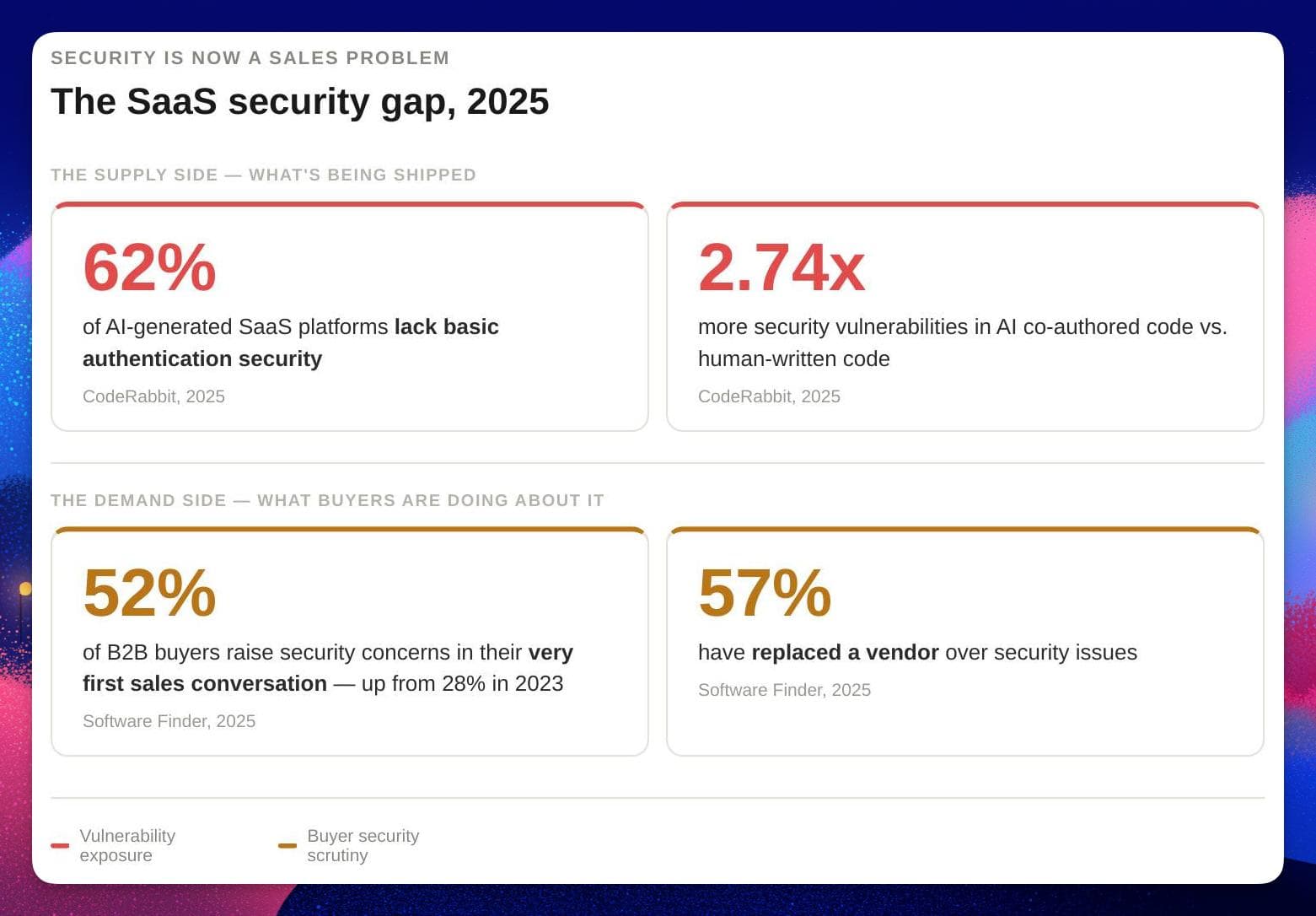
Mid-market buyers won’t trust vibe-coded software, and they shouldn’t
What SaaS founders should realistically concern themselves with:
It’s never been more difficult to get distribution.
This deserves you’re full attention and warrants concern.
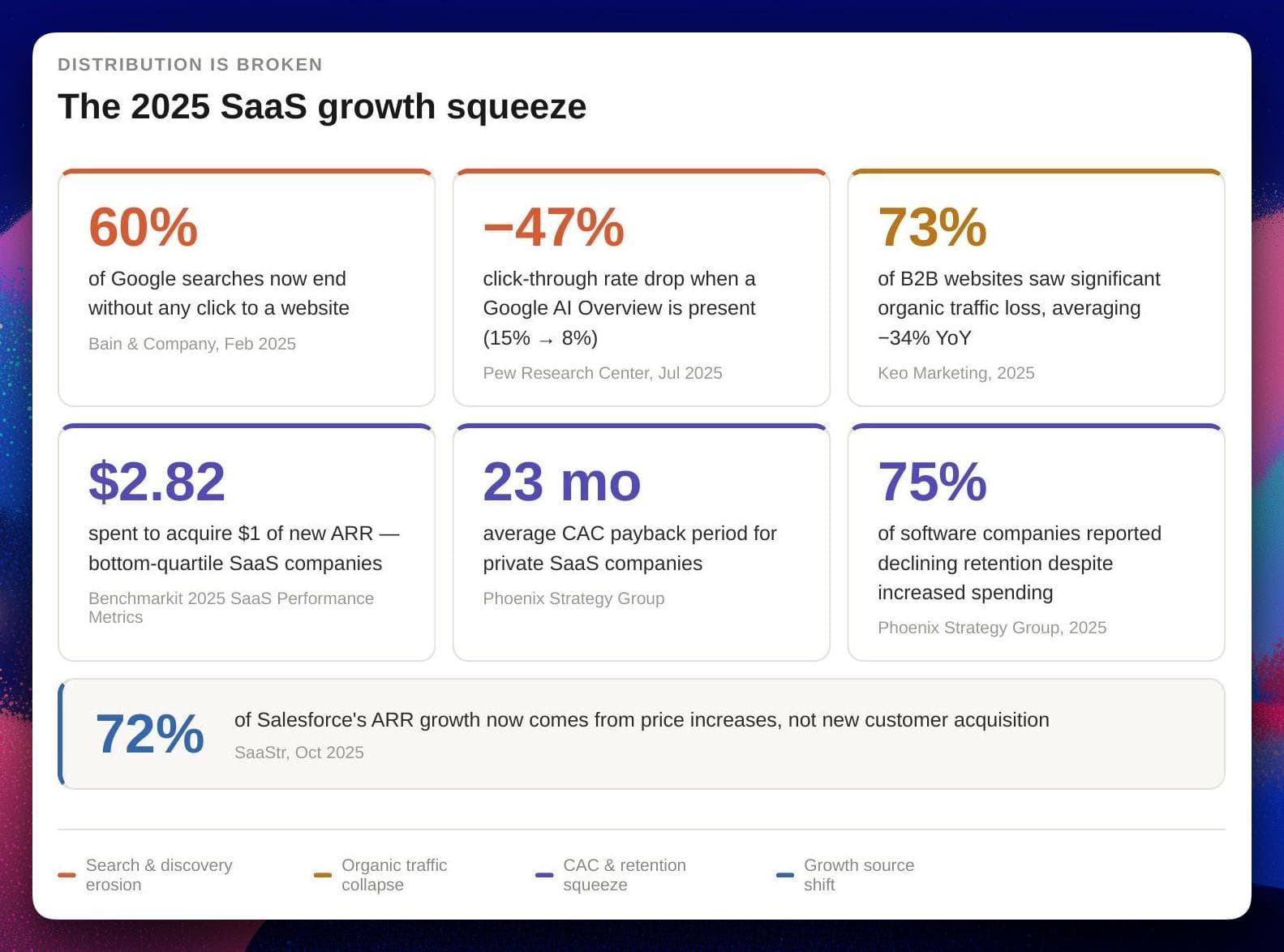
We are in the wild west of SaaS distribution.
If you’re building a SaaS product in 2026 and haven’t figured out your distribution answer to the AI dilemma, I’m going to open-source everything we’re doing in detail below.
Steal whatever’s useful from our playbook.
That’s what this newsletter is for.
The double-edged sword
Let me frame the dilemma honestly, because I think a lot of founders feel this but haven’t named it.
AI has made building software radically easier.
That’s genuinely wonderful.
But AI also creates:
- 10x more products launching every week into every category
- 10x more slop across every channel you’re trying to use
- 10x faster release cycles that compress any feature gap to near zero
- 10x easier to create frivolous features
The tools that let you ship fast are the same tools that let everyone else ship fast. The no-code platforms that let you build without engineers are creating a wave of new competitors who also don’t need engineers.
Look at the customer support platform space (Helply’s market). Lots of venture backed incumbents. Tens of millions in annual spend they can blow on anything.
They can (and do) spin up features very fast.
But they're tacked on. Often discarded shortly after launch. Still legacy software. Still clunky and inefficent.
It's makeup on a pig.
Being intentional is where opportunity is created...
The thing most founders are burying their head in the sand about
There’s a bigger delta than ever between action and outcome.
You ship something great and nothing happens. Ten years ago, you could write one guest post and get 100 signups. Or, you could launch on Product Hunt and ride that wave for weeks.
Today you ship for months before momentum.
We’ve been running growth sprints every single week (getting signups, building awareness, producing content, running outbound). But activation and conversion take time. Sometimes 60-90 days between effort and result.
It took us 12 months to get to $1M ARR. The first 6 months we were almost flat.
There’s a fear in every founder after launch, this low hum in the background that says what if the thing you built just sits there, no matter how good it is?
In a world where everyone can build, that fear is more rational than ever.
Which is exactly why distribution (compounding, multi-channel distribution) is the only answer that makes sense.
I’ll walk you through ours in detail.
Why product is no longer a moat (and what is)
I need to say this directly because it changes how you should be allocating your time, money, and energy:
Product quality is table stakes. Distribution is the moat.
The old world (even five years ago) had natural barriers. Software was hard to build and engineering talent was expensive and scarce. If you had a genuinely better product, you could win on that alone. The product itself was the moat because so few teams could build a good one.
The new world has almost no build barriers. AI compresses feature gaps overnight. Clones can appear in weeks. Everyone has access to the same models, APIs, and infrastructure. And VCs are ready to brute-force every industry with hundreds of millions in spending.
So what separates winners from the hundreds of identical alternatives?
- Reach. Can you get in front of the right people consistently?
- Trust. When you get in front of them, do they believe you?
- Relationships. Do you have direct lines to your customers, or are you renting attention from algorithms?
- Speed of learning. Are you in close enough contact with real users to iterate faster than competitors who are building in a vacuum?
These are distribution advantages. And they’re the only advantages that can’t be cloned in two weeks.
But there’s another reality check here as well.
Distribution itself is getting harder.
Organic reach is unpredictable across every platform. SEO is saturated and is getting disrupted by AI search. Cold outbound is crowded. Ads are expensive. AI is automating spam, which makes every channel noisier.
So even distribution is commoditizing.
The only real edge left is consistent, compounding, multi-channel effort over time. Stacked reps across multiple channels, every week, for months and years.
That’s the bet.
Now let me show you exactly what it looks like.
Positioning: the foundation everything else sits on
Before I walk through channels, we need to talk about positioning, because distribution doesn’t work if your story isn’t clear.
Helply is not positioning as “another help desk.”
We own a specific position:
AI-native support platform built for b2b SaaS companies who want to turn customer support into a revenue engine. No seat fees; only pay for outcomes.
That last point is our sharpest weapon. We've given away the platform for free and believe companies shouldn't have to pay a seat tax in 2026.
Outcome positioning beats feature positioning.
Why this matters for distribution:
Every channel I’m about to walk through works better because the positioning is clear.
Positioning is the multiplier on everything.
Pro tip: If you’re building in a crowded AI category right now, run this test on your positioning. Can you put a specific, measurable outcome in your headline? Not “save time” or “boost efficiency” but a number. A commitment that a prospect could hold you to. If you can’t, your positioning is probably too vague to cut through the noise in any distribution channel.
Channel 1: Founder-led content
The setup: I have 60,000+ ICP aligned followers on LinkedIn. I had < 1,800 followers 365 days ago and I’m growing that number every week through daily content. Only about 20% to 30% is promotional content or stories about building, tactical breakdowns of what’s working, customer wins, revenue updates, and the uncomfortable realities of scaling SaaS companies.
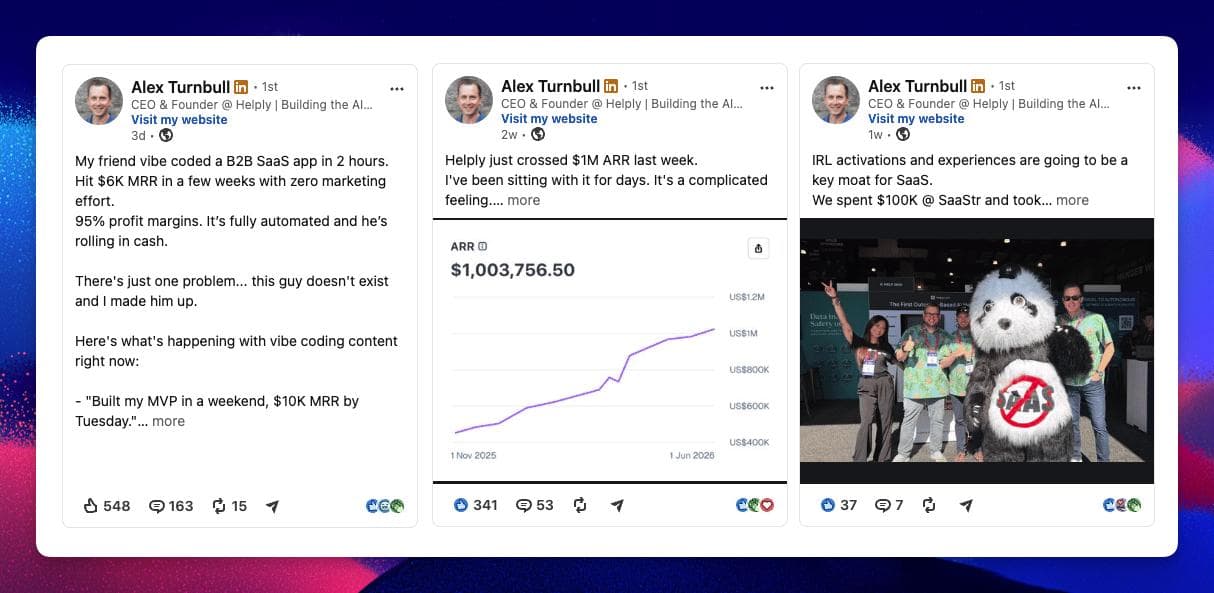
70% is content about my hot takes, war stories, and founder pain points. These exposure level content ideas are relevant and interesting to my ICP (other SaaS founders doing up to $30M ARR).
That’s the exposure level content that brings these people into my gravity.
Why this matters more now than ever:
A founder showing up every day, sharing real numbers, admitting mistakes, and telling real stories builds a kind of credibility that no AI content engine or brand account can replicate.
That trust transfers directly to the products you’re building.
When I talk about Helply on LinkedIn, it’s from a founder you’ve been following for months telling you what he’s building and why.
LinkedIn reach compounds because followers accumulate. Every new follower sees future posts. A post that reaches 5,000 people today might reach 8,000 people in three months and 15,000 in six months with the same effort.
That’s a fundamentally different ROI curve than paid ads, where every impression costs money and reach resets to zero when you stop spending.
Channel 2: Owned audience (newsletter)
You’re sitting inside our second distribution channel right now.
Between this newsletter and our broader email list, we have direct access to 70,000+ SaaS founders and operators. High open rates w/ real engagement and people who actually read what we send.
The key concept: rented audiences disappear. Owned audiences compound.
LinkedIn could change the algorithm tomorrow. Google could tank our search rankings overnight. Ad costs could spike 40% in a quarter. Every channel we don’t own is a channel that can be taken away and in a world where AI is making every channel noisier, that risk is growing.
So you want to bring people deeper into your gravity.
This email list is ours. Every subscriber we earn makes the next product launch easier.
This newsletter is a relationship-building engine that happens to make our products easier to sell and also puts forth more long form, in-depth content for other founders.
The structure:
- Primary value: tactical SaaS content. The playbooks, numbers, and behind-the-scenes access that make this worth reading even if you never touch Helply.
- Secondary value: real-time product journey. As I share our metrics, experiments, and decisions, readers develop a deep familiarity with our products.
- Conversion layer: natural, contextual mentions. When I write about our outbound strategy and mention that Helply’s "no seat fee" is the hook that opens doors - that’s real. It’s not a manufactured CTA.
The compounding effect:
Every issue that’s genuinely useful earns forwards. Forwards earn new subscribers. New subscribers see future issues. The list grows, the reach grows, and the trust deepens, all without spending a dollar on acquisition.
We’ve seen consistent organic growth in subscribers driven almost entirely by readers sharing specific issues they found valuable.
Pro tip: If you’re running a founder-led newsletter, track your forward rate (most email platforms show this as shares or forwards). A high forward rate means your content is good enough that readers are staking their own reputation on recommending it. That’s the strongest signal you have that your content is building real trust, not just getting opened out of habit.
Channel 3: Events
We launched Helply at SaaStr. Over 3 days we locked in over 100 demos, which led directly to us breaking $1M ARR.
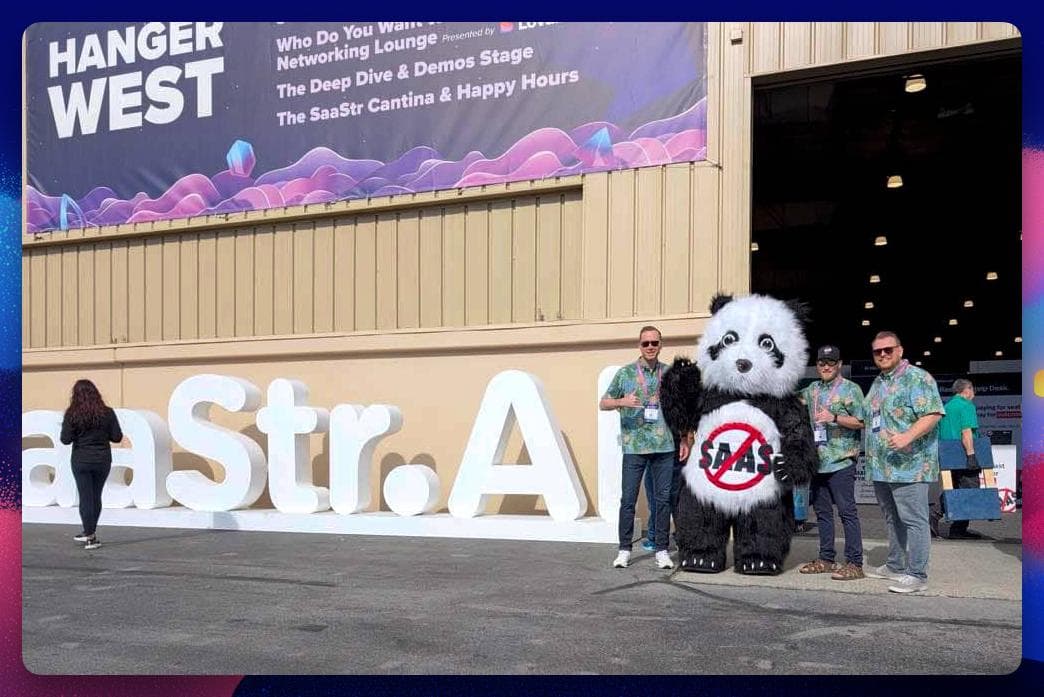
We went big. Spent about $150k on the event. Pandas. Protestors. Big Booth.
And the payoff was undeniable.
Bottom line: we are scheduled for several more events later this year. Our competitors are doing the same. But when you don't charge for seats, you have an unfair advantage...
Channel 4: Direct outbound (hand-to-hand combat)
This is where we get into pure tactical, hand-to-hand selling.
Why outbound still matters in an AI-saturated world:
Every content-based channel is getting noisier. Organic reach is declining. Feeds are flooded. But a well-researched, personalized message to someone with a real pain point still gets read.
Outbound is the one channel that’s 100% in your control, it works even when algorithms change, even when organic reach drops, even when ad costs spike.
Our ICP for outbound:
B2B SaaS companies that want to turn customer support into a revenue engine (and are tired of expensive, clunky legacy software).
We’re looking for:
- Midmarket B2B SaaS companies
- Dedicated support team (minimum 2 support reps)
- $1M - $50M ARR
- Probably currently using a clunky, legacy product like Zendesk, Freshdesk, Hubspot, Salesforce or Help Scout
- More than 500 customer conversations a month
We then built our own engine for sourcing these leads:
- Supabase as the foundation
- Custom AI agents for scraping and enriching leads
- A custom 'listening' engine that lets us know when someone in our ICP needs our help...
- 1x SDR to handle outbound, calls, and booking appointments
Pro tip: If you’re running outbound for an early-stage SaaS product, resist the temptation to scale volume before you’ve dialed in your message. Run 20-30 highly personalized outreaches and track which angles get replies.
Once you know which pain point and which proof point consistently opens conversations, then you can start building sequences around that message. Scaling a bad message just burns your list faster.
Channel 5: Case studies and proof as distribution
In a market where every tool makes bold claims and they all sound the same, proof is a distribution strategy.
Why proof matters more in AI categories than anywhere else: AI has a credibility problem. Everyone claims their model is the smartest, their resolution rates are the highest, their technology is the most advanced.
Prospects have heard it all and they’re skeptical, rightfully so.
The company that shows receipts wins.
What our proof library includes:
- Resolution rate data from real customers, actual percentages.
- Before/after comparisons that show the specific impact on ticket volume, response time, and customer satisfaction scores.
- Screenshots (with permission) showing actual AI outcomes. Churn risk. Expansion revenue. New articles written for the KB. Auto resolved customer inquiries end to end without a human...This is the most powerful proof because it lets prospects see exactly what “AI outcome” looks like in practice.
- Hard ROI numbers, hours saved, cost per ticket before and after, support team capacity freed up
How we use proof across every channel:
We weave proof into everything:
- LinkedIn content
- Outbound sequences
- Newsletter
- Sales demos
Every new case study makes every other channel more effective.
Pro tip: If you’re early-stage and don’t have many case studies yet, start building proof from day one. Ask your first five customers if you can measure and share their results. Offer to do the analysis for them, most customers are happy to be featured if you do the work.
Five detailed case studies with real numbers will outperform a hundred testimonial quotes that say “great product, love it.”
The compounding layer (this ties everything together)
This is the most important thing I’ll say in this entire post, and it’s the piece that turns seven individual channels into a distribution engine.
None of these channels work in isolation. And none of them produce meaningful results overnight.
The strategy is:
- Daily founder content building trust and reach on LinkedIn
- Weekly newsletter issues deepening the relationship with 70,000+ subscribers
- Weekly growth sprints running outbound, optimizing integrations, producing proof
- Monthly case studies adding to the proof library that makes every other channel more effective
- Quarterly retrospectives where we evaluate which channels are compounding and double down
- Year over year trust accumulation that makes every single effort more effective than the last
This is a compounding strategy. And compounding works exactly like interest, the gains are invisible at first, then become unfair over time.
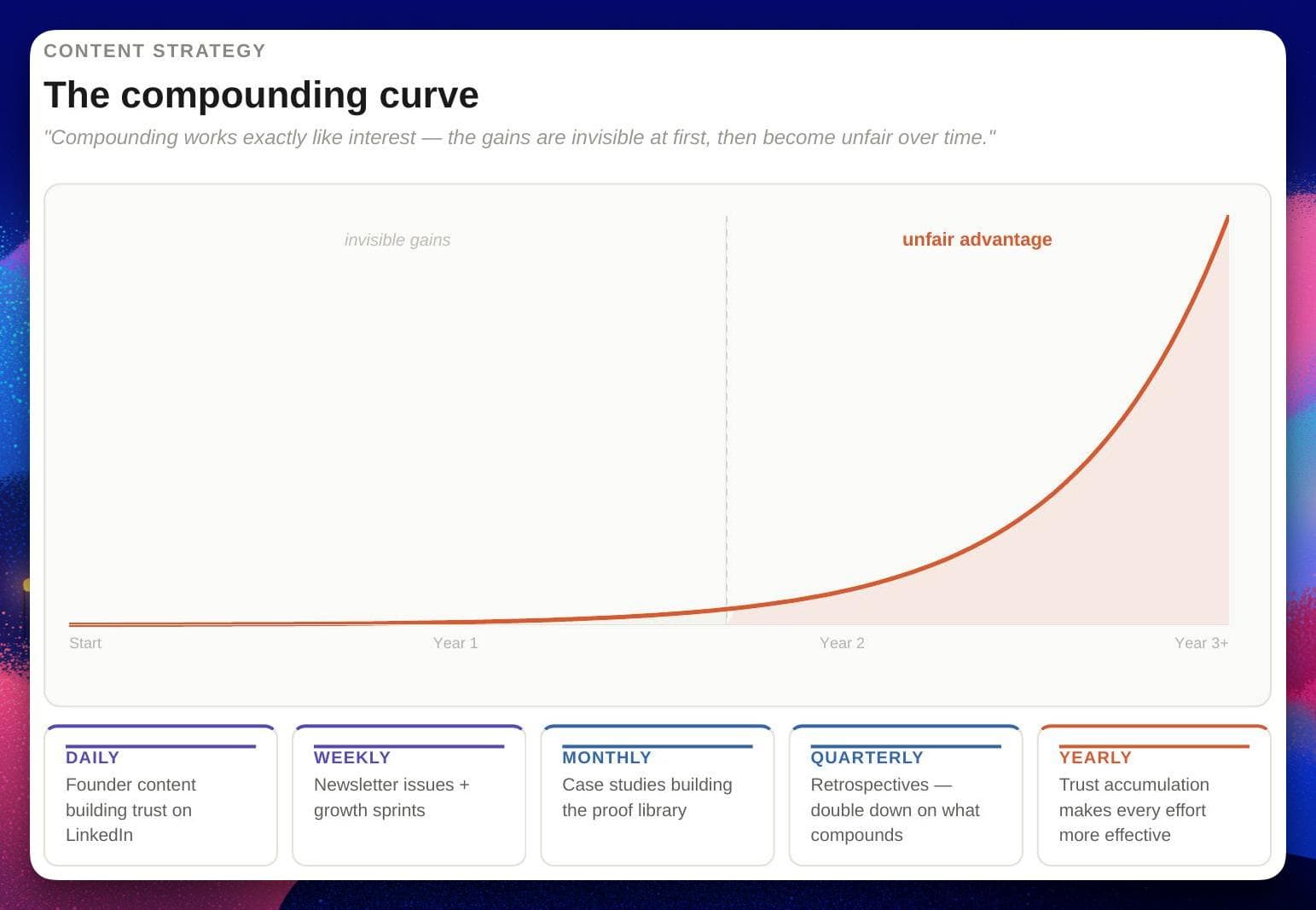
Here’s the snapshot of where we are right now: Early traction.
We’re running growth sprints every week, stacking effort across all seven channels, and the results are finally starting to materialize. Some weeks are bigger than others, but there's always 'something' now (which wasn't the case 10 months ago).
But I’ve seen this movie before. When we built Groove from zero, the first several months were zero. Daily effort, slow results, the temptation to chase a shortcut.
And then, gradually and then suddenly, the compounding kicked in. The content started ranking. The referrals started flowing. The brand recognition tipped from “who?” to “oh yeah, I’ve seen you everywhere.”
It takes time. You have to be able to weather the storm.
The mindset
Let me bring this back to where I started.
We’re building in a world where there's hundreds of millions pouring into VC backed companies. AI makes competition relentless and constant. The gap between effort and result feels wider than it’s ever been.
I can’t control how much spend our competitors have to ship new tacked on features, or how noisy the channels get, or when there's going to be another $400m thrown behind these legacy companies tomorrow to help them build something customers want (e.g. Salesforce acquisition of Intercom).
What I can control is where and how we show up. With real stories, numbers, and proof. Stacking reps while everyone else is chasing hacks or hoping to brute-force it.
We’re betting on being the best in the world for the very narrow niche we serve. And we do that by being the most trusted.
And trust is built the only way it’s ever been built. Slowly, consistently, every single day.
That’s how we plan to win.

